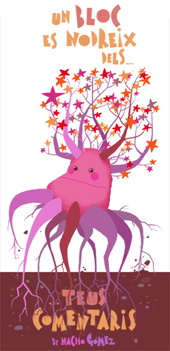
A photo for the New Year - Sebastian 18#365

"In Spain, on New Year Eve, we eat 12 grapes at the sound of the 12 last strokes of the year… one stroke, one grape, one stroke, one grape…
HAPPY NEW YEAR!"
Thanks Camino Z for this!


"In Spain, on New Year Eve, we eat 12 grapes at the sound of the 12 last strokes of the year… one stroke, one grape, one stroke, one grape…
HAPPY NEW YEAR!"
Thanks Camino Z for this!
Having never been to Stoke on Trent previously, I was there twice in three days! This time I'd been invited to speak at a 'Creative Spanish' afternoon for Primary Language teachers, organised jointly by Lorna Harvey from Staffordshire and Helen Thomas from Stoke on Trent. I really enjoyed the presentation on using Art by Shirley Kliment-Temple and was sorry to miss the salsa and skipping!
My presentation was a repeat of the one I did at the Primary Language Show in Liverpool about the QCA unit based on SaintSaens Carnival of the Animals, and I have posted the slidecast from that event below so that you can listen and watch the slides! If yu want any of the resources, they are in this post.
If you have any questions, please feel free to contact me.

Friday was a busy day, starting off in London with an animation course run by Oscar Stringer at Institute of Education.
Working in two groups, we spent the day developing our animation skills, producing two short animations from initial idea to finished film complete with transitions, titles, sound and music. We used ICanAnimate to capture the animation then exported the film to iMovie to 'finish' it. My group used my Mac book and a Hue webcam - and it was lovely to meet the man behind Hue in the UK during the day as well (mine's on order from Amazon - went for the blue one in the end!) whilst the other group used an iMac and a driverless webcam.
James, Carolyn and I took our inspiration from the Mr Men. Firstly, our models followed the principles of Mr Men (which are also important principles for plasticine animation - big features, bold shapes and simple designs) and secondly, we made an animation with a message - suitable for PSHE and based on friendship in the playground - a lonely girl on a bench wanting to join in with a game of ball.
The day reinforced all that I already knew about animating - the importance of keeping things simple, of planning well before you start, of working in collaboration and of how much fun it is!
We laughed so much making the animations - my group's is posted below. This is the English version. We recorded three different ending - with the bench saying THE END in English, French and Spanish - so that we can use it in our classrooms and dub it in different languages.
If you want to find out more about animating, I can't recommend Oscar's courses enough. He has a real gift for making it all seem very simple (and it is) and conveys the great potential that animation has as a tool for creativity, collaboration, innovation and progression. Check out his website and his blog to find out more.
Amazing what you can do with a carpet tile, some plasticine and an idea!
Here are a couple of movies of ideas from the first running of the Creativity in eTwinning workshop this morning.
The first shows some of the ideas raised about creativity and what it feels like to be creative.
The second are the reflections of the Sunglasses group on what they consider to be the ideal conditions for creativity to happen.
A really interesting seminar with lots of discussion about creativity and innovation.
Key ideas included the need for freedom, for space and for the acceptance of diversity; the need to spark ideas in one another, to accept that there are no right and wrong ideas and that the best conditions for creativity can be different for each person. Here are a number of photos taken of the ideas sparked by the session. Perhaps you'd like to add your own comments.

I have made no secret of my love of puppets as evidenced by various blog posts over the last nine months and several dodgy pictures floating around the blogosphere. So a post on Linguahelp captured my attention.
I hadn't discovered the Linguahelp blog before, probably because my school doesn't subscribe to Linguascope. However, my Google alerts today included a link to the most recent post entitled Gimmick sites to help in the MFL classroom and it made lots of sense to me. I'm always up for finding innovative and captivating ways of engaging language learners so the idea of using the Iceland Socks site seemed appealing - and I tried it out!
I followed the advice offered on Linguahelp -
The idea is simple - you build up a mini ‘film’ using sock puppets, subtitles and a series of animated locations, which you can then email to friends - but the usefulness to language learning is immediately apparent. The puppets speak a ‘Pingu-esque’ nonsense chatter, which is made into intelligible dialogue by the user. Students could use the site to build up practice dialogues in a very up-to-date, hi-tech fashion - instead of potentially awkward and embarrassing role-play in class, they can create YouTube style cartoons full of the language they are learning. To top this, the resulting ‘films’ can then be emailed to the teacher for checking later! Not perhaps the original intention of the site designers, but a fun adaptation to liven up the lesson.and you can see the results of my first attempt by clicking on the title, Lucía and Miguel go to Iceland.

*cross post with Animation for Education NING *
Having attended animation workshops, made a few plasticine model animations and talked up the use of animation in PLL (primary language learning), three weeks ago I decided to take the plunge and let the kids show me what they could do!
Year 4 are currently studying a Unit of the QCA Key Stage 2 Spanish Scheme of work that is based on the Saint Saëns musical suite, Le Carnaval des Animaux. I think it's a good unit as it allows lots of different cross curricular links to be made - you can read about it on my blog if you're interested! I had the idea whilst sitting in one of Oscar's workshops of using plastic animals to create an animated 'carnival' as an end of term project for the class - fun but also has a various purposes - enhancing linguistic skills as well as technological ones.
First step was working out how to do it! I bought a MacBook about six weeks ago and, after much deliberation as to whether I was willing to allow 31 9year olds to touch my lovely white Mac, I decided to be brave and use it. I had thought I might need to buy a webcam as the ones in school don't seem to work (not been used for a while ;o) ). However, the Macbook has an iSight camera built in and I wanted to get on with it. Next, I raided the Nursery class for some animals - there were Duplo ones as well but I liked the more 'realistic' looking ones, especially as some had adult and baby sized ones.
Next, I set up the equipment before the class came in and hit my first snag - how to make the animals seen. The iSight was focused higher that the animals and the only way to get the models in camera was to either incline the screen towards the table - not really an option - or to raise the stage which I did with two trays, covered with paper, and the MacBook as near as possible to the trays. I did wonder if the iSight could be 'zoomed' but a quick call to someone in the know told me that I would just have to make the best of it. (I got a tip later that there is something called iGlasses that will make it zoom - I'll be investigating before next time - ta Andrew!) Background was paper on a freestanding whiteboard, as close to the table as possible.
The class arrived and of course, everyone was fascinated by the set up and started crowding around. i like the enthusiasm but it did make some of them a little deaf to instructions! Having explained what we were going to do and how we might achieve it, the pupils got into pairs and chose their animal from the selection. Most had a couple of models for their chosen animal. We discussed our idea and how the 'story' might go, deciding that all the animals are on their way to the carnival; I left it to each group to decide how their animals might move / act on the way, so some are walking, others so excited that they're dancing and the hyena and the tiger are having a scrap!
I demonstrated what they needed to do using the elephants, emphasising small movements, 12 pictures for one second of film and instructing them to keep the animals far back on the stage to make sure they're as big as possible. Then, whilst I taught the rest of the class, I sent one pair at a time to the back table where they animated their section of the film, with the instruction to call the next group when their animals reached the centre of the stage.
The first morning we managed to do about six sets of animals and when we reviewed the footage, there were some speedy animals! A bit too much excitement I think for some to remember all the instructions.
As I have the class for two hours each week for Spanish and RE, I had to pack up the stuff until the next week which had it's problems as the backdrop had been drawn on by the next week, and everything needed resetting. Once done though, the second lot of groups paid more heed to the need for small movements and lots of shots, and by the end of the morning we had an animation!
Today we added 'finishing touches' - titles and credits, sound track and sound effects, and voiceovers using iMovie. It's amazing how long it took to 'finish' 1 minute 20 seconds of film! But then again, it was our first go and there was an air of general madness at school today ;o) ( rain and nearing the end of term!)
Finally, I've just shared it to Youtube from iMovie.
So, reflecting on the experience, I'd say the following;
It's our first attempt - please bear that in mind!!
By the end, the class had grasped the basics so the case of the flying pigs will not happen next time.
Background could've been brighter - we didn't want to detract from the animals but we'd use scenery next time.
I'd definitely want to be able to zoom in / out next time as the animals don't fill the screen.
Although I ended up with a splitting headache - hence my earlier tweet! -it was worth it! The class belongs to the ICT coordinator who was intrigued by what we were doing and several other members of staff came to have a nose at what we were doing. And the class were full of enthusiasm - they increasingly gave constructive criticism and helped one another, and were desparate to see the finished product.
So, here's the premiere (el estreno in Spanish) of El Carnaval de los Animales.
Please leave comments - the kids will love that! and be honest in a kind way please ;o)

I was really excited to read a blog post on Talkabout Primary MFL entitled Theatre in Spanish for Primary children. Clare Secombe, who (amongst other things) is webmistress of the Sunderland MFL site, reported that there is a group called A Cuerpo based in Leicester who offer performances, workshops and resources in Spanish for children aged 6-11.
As Clare rightly points out, Spanish is often the poor cousin of French when it comes to such things so it's great to hear the news. And looking at the A Cuerpo site, I'm even more excited! Here are a couple of extracts about the play they are currently touring - El Viaje de Matilde- check it out for yourself though.

A Cuerpo is thrilled to present El viaje de Matilde (Matilde’s Journey). El viaje de Matilde is a newly devised theatre performance in Spanish with an original script for children aged six to eleven, which offers the unique opportunity to learn Spanish whilst having fun.
El viaje de Matilde is an innovative theatre performance that uses an interaction of film with live theatre, as well as puppetry and music
They provide pre and post performance materials as well as the opportunity to ask questions of the actors; they also offer workshops. WOW!Summary

The main character is a cheeky eight year-old Spanish girl called Matilde (a real size body puppet).
Matilde leads a normal life, she lives in a small town in Spain with her family, goes to school and has friends…but she is not completely happy, as she dreams of travelling to the jungle and having lots of adventures.
Luckily Matilde’s dad is an inventor and he is working on an instant travelling machine…
Well, Matilde can’t help herself and decides to build the machine herself…
As you can imagine things aren’t as easy as they look and Matilde gets into one or two tight spots…
I'm off to contact them now to find out when they can visit, especially as we're supposed to be having a Language Focus Week next academic year!
I blogged about this great site a while back - but thought I'd mention it again, and post a picture of MY Wildself as I intend to mention it tomorrow when I speak about Using ICT in the Primary Language Classroom for Comenius West Midlands in Wolverhampton, and also as I mentioned it in my post about El Carnaval de los Animales.
So here's Lisibo - the Rein-pol-conda-ger-guin-peacock (always said I was a bit mixed up )
As I mentioned in my post on Unit 11, my idea is to use the image above as the stimulus for descriptive writing. Pupils could describe

Earlier this week David Noble tweeted a request for someone to attend a Flashmeeting on 8th May for his Access Network. Seeing it as an opportunity to virtually meet some new people, to help David and to leave school on the bell, I volunteered to share some ideas about using puppets and also some ideas for eTwinning.
On a very hot afternoon six of us met on Flashmeeting with David sharing about using GoogleEarth and also about ScotsEduBlogs. David is much more advanced in his Flashmeeting skills than me and managed to post his URLs using the URL button so they popped up for us - I managed to forget about this facility until too late, and posted any that I used in the chat. I hope that my contribution was helpful - I learned plenty from the part of David's talk that I caught.
Below are the links I promised to post to my blog for anyone who is interested ;o)
Puppets - the following blog posts might interest you -
Inspired in IKEA part2 - ideas for where to get and what to do with puppets
Diez animales- an idea for using puppets with song to demonstrate understanding and increase motivation!
eTwinning
I quoted some of these sites in the meeting but I'll repeat them anyway!
Have a look a the post I wrote last week about my talk at Beaumanor Hall for teachers of pupils with SEN in special and mainstream schools - there are several useful links including to the project at Sackville School run by Anne Jakins I mentioned and to a few projects/ideas I mentioned. You can also find the links to the outcomes of Whitehouse Common's project with Spain.
There are other posts on eTwinning on my blog - use the search feature on the right- perhaps you'd be interested in this one as well.
The British Council site has an eTwinning section and then there is the eTwinning portal where you register your interest, search for partners and can record your project.
And then there is the all important eTwinning Ambassadors page.
I've finally got around to responding to being tagged for the Passion Quilt meme - not once, but FIVE times!
This meme, started by Miguel Guhlin , asks people to consider what their passion in education is, find an image that encapsulates it and explain their passion.
So, thanks to @theokk , @moodlehotpotato, @ajep, @langwitch and @ahenderson, here's my passion.
Entitled Happy Colourful Girl, this picture is described as follows:
'I just gave the girls poster paint with no rules...I told them they were free to paint themselves any way they wanted and they were given clean white T-shirts to wear and use as napkins! They had such fun...what you see is the result of pure child's art...no rules :) '
Whilst I don't think we should abandon the rules completely, this image for me sums up how I think teaching and learning should be -
I loved going to school - I'd fight my parents to let me go when I was ill. You may think that's odd, and it possibly is, but that's what I want for my children - my own and the ones I teach - to enjoy the time they spend at school, learning so much more than how to read and write, experiencing a wide spectrum of activities and wanting to come back day after day to find out more.
Some of you might have expected me to choose something Spanish - and I could easily have done so as nothing stirs me quite like it - but my passion goes deeper than that into all areas of teaching and learning - not being restricted to one subject but encompassing all.
So there you have it!
Now to tag five more people (hopefully who haven't already been tagged!)
1.Leanne Simmonds
2.Rachel Hawkes
3.Dave Stacey
4.Sharon Tonner
5.Adam Sutcliffe
Instructions-
1. Think about what you are passionate about teaching your students.
2. Post a picture from a source like FlickrCC or Flickr Creative Commons or make/take your own that captures what YOU are most passionate about for kids to learn about…and give your picture a short title.
3. Title your blog post “Meme: Passion Quilt” and link back to this blog entry.
4. Include links to 5 folks in your professional learning network or whom you follow on Twitter/Pownce etc.

 Subtitle-

 did - incessantly! I met old friends like Joe Dale, Lesley Welsh, Ewan McIntosh, Chris Fuller and Rachel Hawkes, made new ones like Nick Brown and José Picardo and generally talked to anyone who'd listen! Much fun was had at the wine tasting - I think I hold the record for the most Heinneman coffee mugs acquired in half an hour (not all for me!) followed by a quick visit to the pub before the wine reception and dinner. This was followed by bellydancing - no photos have yet appeared (thank goodness!) but I hear we were a sight to behold! Bed was finally reached in the early hours - I just didn't want to miss a moment of the fun!
I've mentioned before how I think that language learning should not be a stand alone but creatively integrated into the curriculum. Today I've been alerted to a couple of videos that I can see being used to do just that, using works of art as the stimulus for speaking activities.
Helen Myers (of ALL President and MFLResources fame) passed on a tip from Glynis Rumley about Women in Art, a lovely video compilation of many female faces from works of art morphing into one another.

The last session I attended on Friday at PLS was a really tough choice - so many I wanted to attend but I chose ¡Mira Miró!, 'a West Sussex KS2 cross-curricular Spanish / Art project, developed by María Roberts (MFL advisor) and Jane Sedgewick (Art advisor) to escape subject silos.'
Maria introduced the project, designed to be cross curricular, not CLIL (most is in English with some Spanish language), and lasting approximately 5 hours / half a term.
The dual objectives were stated as -
 f
 name might be. they were encouraged to comment on the form, colour, texture, lines etc of the piece. The title is Ciphers and Constellations in love with a woman - does it suit the piece? What might be a a better name?
 nd quirky - perhaps they could emulate it?

She shared that deep learning was the underpinning concept – how can learning be made memorable? She shared that key thoughts included a learning journey, first hand experience, use of environment, focus on talk, quality texts, celebrating learning, and making meaningful connections. A couple of aspects I’d pick out as particularly interesting are
Exciting contexts –The Romans became ‘Empires and Eruptions /Les empires et les éruptions’; Underwater worlds sounds much more mysterious called ‘The hidden forest / le foret cachée’; Prehistory was renamed ‘Lost World / Les mondes perdus’
Stunning starts and fabulous finishes – each project (lasting a term) had a really special opening activity or experiences – and the kids were hooked, inspired, gobsmacked, the lot for the whole topic. Equally, the end of the project was celebrated and had a ‘fabulous finish’ – bookending the experience.
Some examples of the starters-
- Voyage dans l’inconnu began with the pupils returning from Christmas to discover a crater in the school grounds, containing bits of metal and an advert for ‘jeunes astronautes’ in French, calling for fit young people.
- For Les empires et les eruptions, Dr Who arrived in the school hall in his TARDIS, covered in volcanic ash having escaped
- Les mysteres de Paris – pupils ‘flew’ to
So – what sort of things did they do?
I’ve taken pictures of some of the plans- hope you can read them :o
 (A tip - if you click them, they get bigger!)

(please excuse the scribbles - can't find the 'blank' copy I picked up)
At the end of the project, the results were really exciting. Benefits included:
After an early start to get to 
Having checked it out, I’ll tell you, José, and anyone else who’s interested in my opinion!
The post is called 'Primary Schools 'have got worse' - I don’t like the title – designed for maximum impact obviously! Primary schools ‘have got worse’ – compared to when?? The kernel of the article is that the various bodies reviewing the primary curriculum will report that whilst results in tests are higher, this is due to the increased focus on literacy and numeracy at the expense of others areas of the curriculum."While test scores have risen since the mid 1990s, this has been
achieved at the expense of children's entitlement to a broad and
balanced curriculum and by the diversion of considerable teaching time
to test preparation."
I would agree that there is a huge emphasis on literacy and numeracy in schools – basically because that’s how the school is judged by many. League tables report on SATs results, not the exciting visit from a local artist, or the afternoon spent lying in the school grounds counting mini beasts.
Year 2 and 6 at school are dominated by SATs – booster classes, practice papers and all – and the rest of the school is affected too as the ICT suite is out of action as an extra classroom. (Not such as big problem this year as we have laptop trolleys in KS2, but KS1 and Foundation are affected)
And we have assessment week for the whole school several times a year during which pupils are under pressure to raise their levels in literacy and numeracy.
I recall being working hard in numeracy and literacy at middle school – lots of mental arithmetic, and tricky spellings, and the like. But I also recall spending whole days painting huge pictures of the Victorians, or a week of working independently on personal topics – I did one about Scandanavia and on another occasion, Sign Language and Braille. Perhaps I have a rosy view of my school days – I did like school- and have forgotten how much time we spent on different sections. We had a test every year – we all went into the hall and did three tests but it wasn’t pressurised, nor had we been ‘hothoused’ to pass them, and we didn’t have SATs.
The LibDem Education spokesman David Laws said "Young children should follow a broad and balanced curriculum. Too much time in primary schools is now spent on test preparation. Creativity is at risk of being squeezed out of our classrooms.”
I’ve blogged before about my wish for creativity, and creative subversion in the primary curriculum, and I don’t think that being a good school with high levels of literacy and numeracy should exclude a creative approach to teaching and learning.
At the Primary Language Show, I’ve heard about several cross curricular projects involving languages, and all have reported increased levels in basic skills as well as the kids having a marvellous time, doing unforgettable things that have blown their minds. I’ll try and find the time to blog about as many as I can (hopefully others will too, eh Joe and Jo??) as I really think school is about more than stuffing minds with facts and coaching kids to pass exams.
What do you think?

What do the Kaiser Chiefs, The Bangles and the Pink Panther have in common? Not much you might think, but all provide the backing to French songs demonstrated today by Steph Hopkins at her conference Creating a compelling curriculum.
Steph went on to talk about the rhythms of French, clapping phrases to enable the cadences of the language to be more apparent, and to enable good intonation as well as pronunciation. I’ve always found this effective in PLL as it is something with which pupils are familiar from literacy. I liked the use of ‘encore’ by the pupils to ‘boss around’ the teacher that Steph cited – shows that they have engaged with the task.
Pigloo then made an appearance with a couple of exercises to complete as we listened to the little penguin’s take on YMCA Moi j’aime skier – ordering a text, grouping words from the song and a gapped text with all –er verbs missed out. A comment was made that there was more interest in learning the dance than the lyrics, but, as Steph pointed out, if you’re watching it enough times to learn the dance, something must be going in of the lyrics!

I have now officially been up for 12 hours (it’s 4.45pm!) and could do with a snooze, but I can’t because a) I might sleep past by stop, b)my contact lenses will stick to my eyes and c) my mind is buzzing!
My session was entitled Keeping it compelling (more of that later!)
The day consisted of sessions led by Steph in the morning about the new Secondary Curriculum, the SLNs and then a session on phonics rhythm and song, followed by workshops in the afternoon
CLIL led by Louise Wornell from Ringwood
Podcasting with Steph
Blogging and wikis with Alex Blagona from
Keeping it compelling with me.
Once more, I would’ve liked to attend all the other sessions, and am hopeful that I’ll be able to catch some of them – sure Joe Dale had all his iRivers in action ;o)
Steph’s sessions were really interesting for me. As an ex-Secondary MFL teacher it was good to see how the curriculum has changed in the few years since I taught it, moving towards a more creative approach and less proscriptive content. Almost made me miss it – I did say nearly! I’m sure it would be very different. We considered how MFL can contribute to the whole curriculum dimensions of the Big Picture such as
It was also good to see how things have changed from the point of view of informing what happens at KS2. It makes sense to me that KS2 practitioners need to have an understanding of what is happening at KS3 just as KS3 need to be aware of the KS2 Framework for their work to make sense. It’s all about being ‘joined up’ or ‘pulling together the threads’ of language learning.
There were some very interesting snapshots offered from various members of the SLNs represented at the event. They have chosen to focus on boys’ attainment and use of TL, and I really enjoyed hearing about the creative ways in which schools were addressing these aspects. One group of lads at Fernhill have been split into two teams competing in a Bundesliga to win points for their team – Bayern Munchen or Werder Bremen – with points awarded for use of TL and against for poor teamwork such as calling out. Another school were using the pupils’ interests as the focus for work on healthy lifestyles, having a lesson lead by a group of pupils on an aspect of the topic such as sport, diet etc. And
Steph’s session on Phonics, Rhythm and Song deserves a post of its own – so it shall get one!

In the previous post, I suggested some ways to use items from IKEA in my teaching. Storage, cushions and soft shoes were all mentioned. This post focuses on items to enhance and facilitate speaking and listening in PLL.
One of the main obstacles I find in getting pupils to speak Spanish (or French, German, or any other language) is the 'hang up' that it sounds funny. Whilst this is not such a big problem, in my experience, in PLL, there is still some reticence on the part of some pupils to speaking the foreign language. Using puppets is one way of getting around this. Puppets come in all shapes and sizes - you can download patterns for card finger puppets here and here: you can use sock puppets - see Jo Rhys-Jones' video in which pupils converse using their alien sock puppets; you can use glove puppets - I have a HUGE collection of those (including Ana and Jaime); and you can use finger puppets.
As well  as charity shops , jumble sales and my childrens' toyboxes, IKEA are the m
 ain source of my finger puppets. TITTA are sets of 10 finger puppets, costing £5. I have three sets (about time they brought out a new set!) - a sea set (right), a fairytale /royal court set (not pictured) and a jungle set (left). Pupils prefer the animals and give them names and different voices. By using the puppets they are distancing the 'funny noise' that some of them associate with speaking Spanish etc and displacing it onto the puppet. Using silly voices is another useful ploy - and is encouraged - as long as the voice doesn't make understanding impossible! Additionally, puppets seem to increase confidence and encourage creativity in a way that 'turn to your partner and practice the phrases' doesn't. Not hard to see why when you're dealing with kids who associate role play with using props and dressing up and having fun.
If you were at the IoW conference in October, or even read about it, you may have seen a picture of me as a cat! For the benefit of those who haven't, here it is! The previous week I had popped over to our nearest IKEA in search of gingerbread for Christmas and come across these lovely animal masks and ears! There's cat, a dog (with floppy ears on the mask), a rabbit (ears on a headband as well as mask) and a bear. I've used these in a similar way to the finger puppets - these give pupils even more to 'hide behind' as they are masked! We've used them for storytelling and for songs like El granjero tiene una granja. Always a clamour to wear them so there's the incentive to take part and contribute to the lesson too, as 'I only choose people who are working hard and trying their best' ;o)
Well today, I made another discovery - more masks and this time not just animals! An alien with antennae, a flower, a spider, a princess, a dinosaur, a ladybird and a bumblebee form the latest set of play masks. This time I managed to find two 'willing' volunteers to model them for me (although I didn't completely escape as you can see!).